These statements have not been evaluated by the Food and Drug Administration. This service is not intended to diagnose, treat, cure, or prevent any disease. It is essential to consult with a qualified healthcare professional for any health concerns or before making any decisions related to your health or treatment.
Ready to try HBOT? Book your first session online.
Why Bryan Johnson Recommends an Air-Pressurized Hyperbaric Chamber
Hyperbaric Chamber
Safety
Longevity
Hyperbarics
HBOT
This article is for educational purposes only and is not medical advice. OxyRenew provides hyperbaric oxygen sessions for general wellness, not to diagnose, treat, cure, or prevent any disease or condition. Hyperbaric chambers are FDA-cleared medical devices only for certain medical conditions, and OxyRenew does not provide medical treatment. Always consult a qualified healthcare professional about any health concern.
Learn the difference between 100% oxygen hospital chambers and air-pressurized wellness chambers, and why the environment inside matters for fire safety and comfort.
HBOT protocols alternate 20 minutes of oxygen with 5 minutes of air at pressure. Why the breaks exist, what Bryan Johnson's protocol and the longevity trials specify, and why many Los Angeles chambers can't deliver them.
Hyperbaric oxygen therapy and breathing oxygen from a mask, an oxygen bar, or a home concentrator differ in one variable: pressure. Learn how the oxygen your blood carries depends on pressure, why oxygen bars and mild soft-shell chambers deliver less, and where a 2.0 ATA hard-shell chamber fits.
These statements have not been evaluated by the Food and Drug Administration. This service is not intended to diagnose, treat, cure, or prevent any disease. It is essential to consult with a qualified healthcare professional for any health concerns or before making any decisions related to your health or treatment.
Ready to try HBOT? Book your first session online.
Bryan Johnson's published HBOT protocol specifies a hard-shell chamber pressurized with ordinary air, with oxygen delivered through a face mask, and it cautions against chambers whose ambient atmosphere is oxygen. Many people assume a chamber filled with oxygen must be the stronger version of the therapy. The oxygen your blood carries is set by the pressure and by the gas you breathe, not by the gas around your body, and the trials his protocol is modeled on delivered oxygen by mask in air-pressurized chambers. This post explains the two designs, what his three cautions rest on, and what hyperbaric safety standards say about each.
Two Ways to Pressurize a Hyperbaric Chamber
Chambers pressurized with oxygen. The chamber fills with oxygen and is compressed, and you breathe the chamber atmosphere with no mask. Most US hospital chambers are this type, an acrylic monoplace cylinder that treats one patient lying down, and it is the main alternative you will find in Los Angeles.
Chambers pressurized with air. The chamber fills with compressed air, and you breathe oxygen through a mask connected to a separate supply. Hospital multiplace chambers work this way, and so do hard-shell chambers built for wellness use, including the one on Johnson's page and the one at OxyRenew. The UHMS Safety Committee notes that the atmosphere in these chambers is kept close to normal air under the NFPA 99 health care facilities code.
In both designs the gas you inhale is oxygen at chamber pressure (read how pressure sets the oxygen dose). The chamber environment differs in its fire rules, in what you can bring in, in how a break works, and in how quickly oxygen exposure can be ended.
What Bryan Johnson's Protocol Page Says
His protocol page lists the equipment as a hard-shell hyperbaric chamber with "ambient pressurized air (normal 21% Oxygen)" and oxygen "delivered through a face mask," run at 2 atmospheres for 90-minute sessions of 20 minutes of oxygen followed by a 5-minute air break, repeated. It then advises readers to avoid chambers whose ambient atmosphere is oxygen because they irritate the eyes and cause cataracts, carry a higher ignition risk, and make it harder to take a break or stop a session. He is reporting his own regimen rather than issuing clinical guidance, so each reason is checked below against the published evidence.
Ignition Risk
Oxygen makes the materials around it easier to ignite, so a chamber pressurized with oxygen has to be run under strict fire rules, with cotton clothing only and nothing electronic or personal inside. Hospitals follow those rules and their record is good. The Undersea and Hyperbaric Medical Society's review of chamber fires (Sheffield and Desautels 1997 ) found that chambers pressurized with air fared far better than those filled with oxygen.
An air-pressurized chamber keeps the atmosphere close to ordinary air and confines the oxygen to the mask circuit, so it is much safer here, and phones, tablets, and laptops are allowed inside. Cotton clothing and a short prohibited-items list still apply at OxyRenew, as at any hyperbaric facility; read about safety at OxyRenew.
Eye Effects
Cataract is the serious eye effect reported with hyperbaric oxygen, and it comes from oxygen reaching the lens. Palmquist et al. (1984) followed 25 patients through 150 or more hyperbaric exposures, and 7 of the 15 who began with clear lenses developed a nuclear cataract, which the authors attributed to oxidative damage to lens proteins. Heyboer et al. (2017) , reviewing HBOT side effects, describe cataract and the milder, temporary myopic shift as two levels of severity of the same lens oxygen toxicity, and note that cataract has been reported only after prolonged courses, usually 150 treatments or more.
How much oxygen reaches the lens depends partly on whether the eyes themselves are in oxygen, which they are for the whole session in a chamber pressurized with oxygen and are not when you wear a mask in an air-pressurized chamber. Bennett et al. (2019) randomized 120 patients to oxygen by mask or by a hood that encloses the head in oxygen and measured about half the lens change with the mask; the authors wrote that their data support the use of an oronasal mask in an air environment when possible. Heyboer et al. put the reduction in overall lens oxygen toxicity with a mask at about half and conclude that patients should be offered the choice of delivery system where available.
Air Breaks and Stopping a Session
HBOT protocols alternate oxygen with short periods of breathing air, usually 5 minutes of air after every 20 minutes of oxygen, to keep the risk of oxygen toxicity low; read why air breaks exist and what the 20/5 cycle does. In an air-pressurized chamber the technician switches the oxygen supply off (or you lift the mask), you breathe the chamber's air, and the pressure does not change. In a chamber pressurized with oxygen the atmosphere is the treatment gas, so a break depends on a separate air supply fed through the chamber wall, and StatPearls notes that some monoplace chambers are not fitted with one. Stopping works the same way. A patient who feels unwell has the oxygen switched off at once, and the technician decides what to do next while the pressure holds; in an oxygen atmosphere, ending the exposure requires the air system or a decompression. The MSD Manual lists limited access to the patient as a drawback of monoplace chambers. At OxyRenew the CHT is in the room for the whole session and can see and speak with you throughout.
What Hyperbaric Standards and the Trials Say
The hyperbaric standards bodies write for hospital treatment, not wellness sessions, so no official statement says to use an air-pressurized chamber for elective use. The standards and studies that exist support each of Johnson's three concerns. NFPA 99 keeps the air-pressurized chamber's atmosphere close to normal air and governs what may enter any chamber. The Bennett trial recommends a mask in an air environment where possible. The National Board of Diving and Hyperbaric Medical Technology holds that every clinical chamber be equipped for air breathing, and UHMS accreditation standards require the operator to be present, with visual or audible contact, for the entire session.
Hachmo et al. (2020) and Hadanny et al. (2020) , the Shamir Medical Center studies of telomere length and cognition in older adults that Johnson's protocol is modeled on, ran 90-minute sessions of oxygen by mask at 2 ATA with 5-minute air breaks every 20 minutes in an air-pressurized multiplace chamber. Read more about HBOT and longevity.
Where Oxygen-Filled Chambers Make Sense
Chambers pressurized with oxygen are standard equipment in hospital hyperbaric medicine. Clarke writes that monoplace chambers dominate the practice of hyperbaric medicine in the USA, adopted as a more economical, less complex alternative to the multiplace chamber, and under NFPA 99 and UHMS standards they have run in hospitals for decades. If a physician orders HBOT for a medical condition, the chamber type is a clinical decision made for you. For elective sessions repeated several times a week over months, devices inside, a break at the turn of a valve, and a technician who can end oxygen exposure at once matter more than footprint and cost, so hard-shell chambers built for wellness use, his and ours included, are pressurized with air.
The OxyRenew Chamber
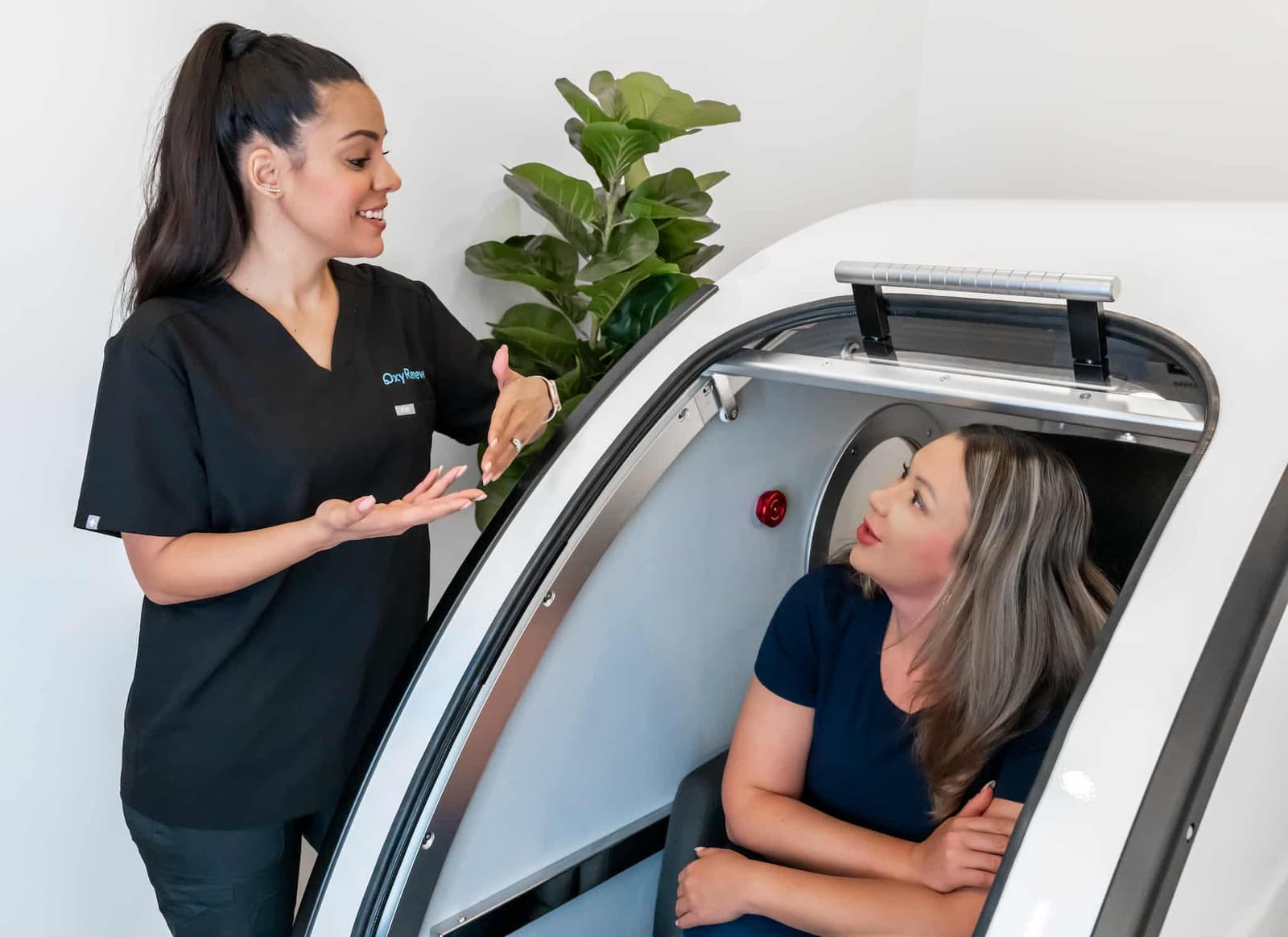
The OxyRenew chamber is a hard-shell unit pressurized with air to 2.0 ATA, with oxygen delivered by mask or cannula, the same design Johnson's page describes. A Certified Hyperbaric Technician is assigned to you and stays with you for the entire session, and runs every air break by switching the oxygen off for about 5 minutes after every 20 minutes of oxygen; your mask or cannula stays on and you breathe the chamber's air. You sit rather than lie down, in a private room, and you can use an iPad or your own devices during a session. Learn more about what a hyperbaric chamber is and what to expect in your first session.
How to Tell Which Chamber a Clinic Has
Ask whether the chamber is pressurized with air or with oxygen and whether you wear a mask; without a mask, the atmosphere is the treatment gas. Ask whether you can bring a phone or tablet inside, which only an air-pressurized chamber allows. Ask what pressure it reaches, since soft-shell chambers are also pressurized with air but stay below 1.4 ATA while the trials above ran at 2 ATA. Read why your choice of chamber matters.
Book a Session in Los Angeles
Sessions are 60, 90, or 120 minutes at our West Hollywood clinic near Cedars-Sinai, and packages of up to 20 sessions are available for anyone following a multi-week protocol; see pricing and packages. Book your first session online, or contact us to speak directly with a Certified Hyperbaric Technician.