These statements have not been evaluated by the Food and Drug Administration. This service is not intended to diagnose, treat, cure, or prevent any disease. It is essential to consult with a qualified healthcare professional for any health concerns or before making any decisions related to your health or treatment.
Ready to try HBOT? Book your first session online.
Oxygen Breaks in HBOT: Why the 20/5 Air Break Protocol Matters
Safety
Oxygen
Longevity
Hyperbarics
HBOT
This article is for educational purposes only and is not medical advice. OxyRenew provides hyperbaric oxygen sessions for general wellness, not to diagnose, treat, cure, or prevent any disease or condition. Hyperbaric chambers are FDA-cleared medical devices only for certain medical conditions, and OxyRenew does not provide medical treatment. Always consult a qualified healthcare professional about any health concern.
Bryan Johnson's protocol specifies a hard-shell chamber pressurized with air, with oxygen by mask, and cautions against chambers filled with oxygen. What the two designs are, what the evidence says about fire risk, eyes, and air breaks, and what hyperbaric safety standards require.
Hyperbaric oxygen therapy and breathing oxygen from a mask, an oxygen bar, or a home concentrator differ in one variable: pressure. Learn how the oxygen your blood carries depends on pressure, why oxygen bars and mild soft-shell chambers deliver less, and where a 2.0 ATA hard-shell chamber fits.
Learn the difference between 100% oxygen hospital chambers and air-pressurized wellness chambers, and why the environment inside matters for fire safety and comfort.
These statements have not been evaluated by the Food and Drug Administration. This service is not intended to diagnose, treat, cure, or prevent any disease. It is essential to consult with a qualified healthcare professional for any health concerns or before making any decisions related to your health or treatment.
Ready to try HBOT? Book your first session online.
A session at OxyRenew alternates about 20 minutes of oxygen through the mask with about 5 minutes of breathing the chamber's own air, all at 2.0 ATA. The intervals are called air breaks, or oxygen breaks, and they are written into the hyperbaric protocols patients ask about most, including the one Bryan Johnson published . Many chambers marketed in Los Angeles either cannot deliver them or do not run them.
What an Oxygen Break Is
During oxygen breathing you wear a mask or cannula fed from the oxygen supply. For a break, the oxygen is switched off and you breathe the air inside the chamber, which is normal air at 21% oxygen held at 2.0 ATA. After about 5 minutes the oxygen comes back on. The pressure does not change during a break, and air at 2.0 ATA carries about twice the oxygen partial pressure of air at sea level, so the break lowers your oxygen dose without pausing the session. On the published 20/5 cycle, 90 minutes at pressure contains three breaks and about 75 minutes of oxygen breathing.
Why Air Breaks Exist: Oxygen Toxicity
Oxygen toxicity depends on pressure and time. Breathed long enough at a high enough pressure, oxygen produces reactive oxygen species faster than the body clears them, and the excess damages cell membranes. In the brain the endpoint is a seizure; in the lungs, irritation and a drop in lung capacity. Heyboer et al. (2017) reviewed the mechanism and noted that the exposure needed to cause a convulsion shortens as the oxygen pressure rises.
The risk during routine treatment is small. Hampson and Atik (2003) recorded 6 seizures in 20,328 treatments at one center, an incidence of 1 in 3,388. StatPearls puts the risk at 2 ATA or below near 1 in 10,000 treatments. Lung effects take far longer: in Clark et al. (1999) , the exposures used to measure pulmonary effects at 2.0 ATA averaged nine hours of continuous oxygen, far beyond any clinical session.
Air breaks are how protocols keep exposure inside those limits. The US Navy's Treatment Table 6 is built from 20-minute oxygen periods separated by 5-minute air periods, and clinical hyperbaric medicine adopted the same cycle. The evidence that the break itself helps has grown. Hendricks et al. (1977) exposed five volunteers to oxygen at 2 ATA on a 20-minutes-on, 5-minutes-off schedule and found that nearly twice the total oxygen time was needed to produce a marked drop in vital capacity compared with continuous breathing. Costa et al. (2019) reviewed 188,335 sessions at a single center over 20 years: after one 5-minute air break was added to the routine protocol, seizure frequency fell from 3.9 to 1.2 per 10,000 sessions. Heyboer et al. had noted two years earlier that the effect of air breaks on seizure incidence had not been directly demonstrated. The Costa series provided that data.
The Hyperoxic-Hypoxic Paradox
The breaks may also drive part of the benefit. Hadanny and Efrati (2020) described what they call the hyperoxic-hypoxic paradox: fluctuations in oxygen level, rather than the absolute level, can be interpreted at the cellular level as a shortage of oxygen. The authors propose that repeated intermittent hyperoxia can induce many of the mediators usually triggered by hypoxia, including HIF-1α and the repair pathways downstream of it, without the harm of actual hypoxia. Each break lowers tissue oxygen from the elevated level back toward baseline, which is the fluctuation the paper describes.
The trials that used the 20/5 cycle state the reason. Hachmo et al. (2020) wrote that their protocol included three air breaks in each session "to utilize the hyperoxic hypoxic paradox and minimize the risk of oxygen toxicity." Hadanny and Efrati call the mechanism a hypothesis, state that the optimal pressure, timing, and number of exposures are not yet known, and disclose ties to AVIV Scientific. The breaks are the part of a session that produces the fluctuation.
The Protocol Bryan Johnson Followed
Bryan Johnson's protocol page lists his HBOT settings: 90-minute sessions at 2 atmospheres, "20 min followed by 5 min air break, repeat," in a hard-shell chamber pressurized with ordinary air and oxygen delivered through a face mask. The same page cautions against chambers whose ambient atmosphere is oxygen, in part because it is "harder to take a break or emergency stop the session." Read why he recommends an air-pressurized chamber.
Whether you get air breaks is decided by two things: how the chamber is pressurized, and who is running the session.
Chambers pressurized with oxygen. The atmosphere inside is the treatment gas, so removing a mask changes nothing. Clarke (2020) notes the monoplace chamber was originally designed to deliver oxygen continuously, with no provision for air breathing. Adding breaks requires an air-break assembly: an air source, regulator, hoses, and a mask fed through a penetrator in the chamber wall, which the operator has to set up and switch. StatPearls states that some monoplace chambers do not have air hoses to allow for air breaks during treatment, and Harch and Rhodes (2024) traced toxicity cases to monoplace chambers that were not equipped for breaks or did not use them. The National Board of Diving and Hyperbaric Medical Technology's position is that every clinical chamber, regardless of type, be equipped to provide intermittent air breathing.
Soft-shell chambers. The inflatable chambers found in gyms and homes operate below 1.4 ATA. The Undersea and Hyperbaric Medical Society notes they are cleared for use with air only, that the FDA prohibits supplemental oxygen in them, and that mild exposures with air deliver no more oxygen than breathing oxygen by mask at sea level. Where an oxygen concentrator is added, one published setup measured about 24% oxygen inside the chamber. There is no sustained oxygen exposure to interrupt, and it is not the protocol the studies used. Read why your choice of chamber matters.
Air-pressurized chambers without someone running the cycle. In an air-pressurized chamber the break requires only switching the oxygen off, but someone has to run each cycle. The physician sets the frequency and duration, and the chamber operator times it and cues the patient. UHMS accreditation standards require the operator to be physically present with visual or audible contact for the entire session. Whether the breaks happen depends on that person being in the room for the whole session.
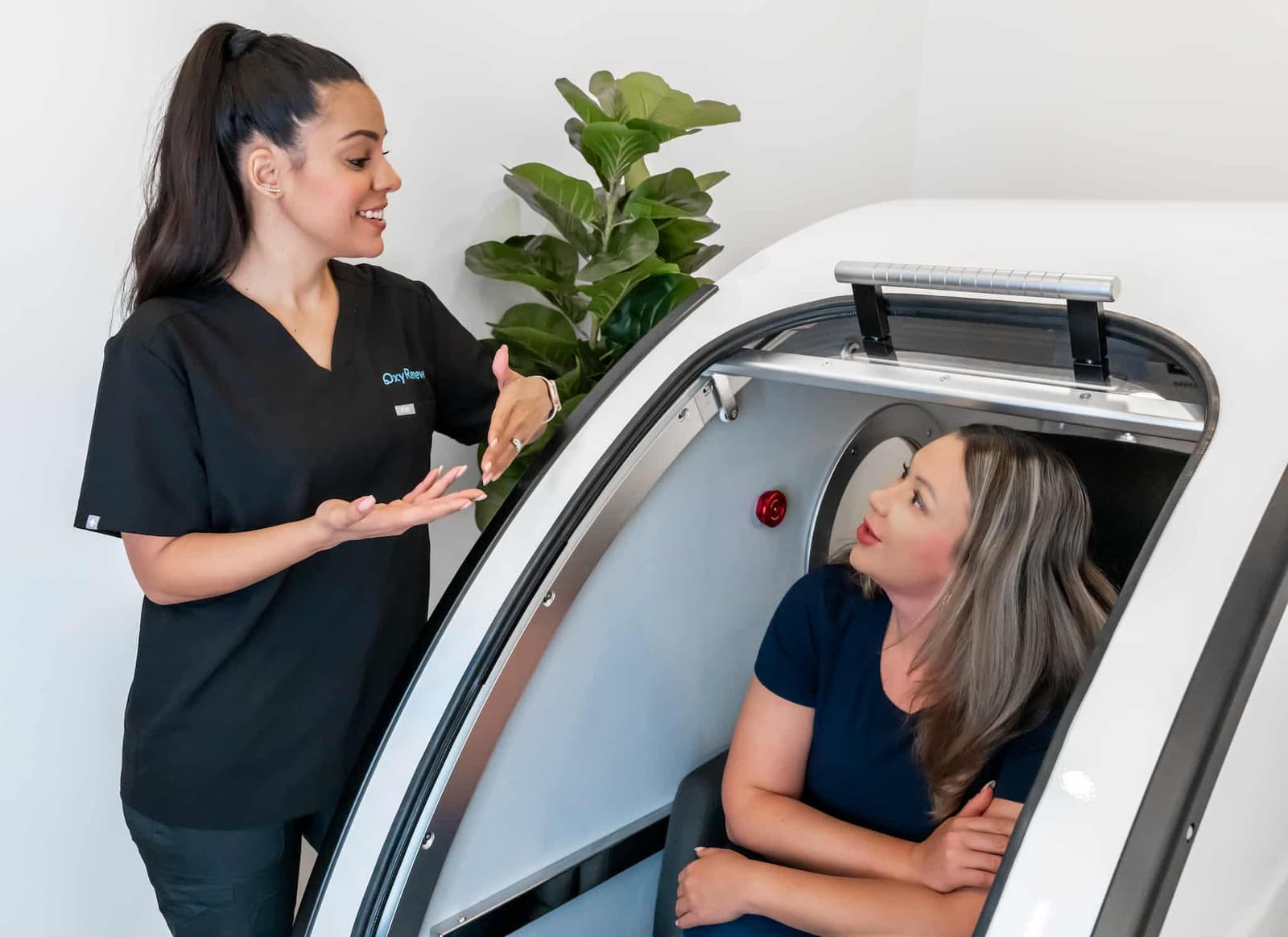
The OxyRenew chamber is a hard-shell unit pressurized with air to 2.0 ATA, with oxygen delivered by mask or cannula. A Certified Hyperbaric Technician is assigned to you and stays with you for the entire session, and runs every cycle: oxygen on for about 20 minutes, off for about 5, back on, while your mask or cannula stays in place. You can use an iPad or your own devices during a session, breaks included. Learn more about what a hyperbaric chamber is and about safety at OxyRenew.
What to Ask Any Clinic
Three questions settle whether a clinic can run this protocol:
Is the chamber pressurized with air or with oxygen? Air-pressurized chambers take a break by switching the oxygen off. Oxygen-pressurized chambers need a separate air-breathing system, and not all have one.
What pressure does it reach? The longevity trials above ran at 2 ATA. Soft-shell chambers stay below 1.4 ATA.
Who runs the air breaks, and are they in the room? The cycle has to be timed and cued by a person for the whole session.
Do the Breaks Reduce the Benefit?
The pressure stays at 2.0 ATA throughout a break, so plasma continues to carry extra dissolved oxygen while you breathe air. On the 20/5 cycle, 90 minutes at pressure still contains about 75 minutes of oxygen breathing, the same amount the trials above delivered, and those trials ran every session with the breaks included. Read a full walkthrough of what to expect in your first session.
Book a Session in Los Angeles
Sessions are 60, 90, or 120 minutes at our West Hollywood clinic near Cedars-Sinai. Packages of up to 20 sessions are available for anyone following a multi-week protocol; see pricing and packages. Book your first session online, or contact us to speak directly with a Certified Hyperbaric Technician.